

The Suicide PR Problem
Why Inconsistencies in How We Talk About Suicide is Actually a HUGE Issue That May Only Hurt More People (Reader Discretion Advised)

Seven months. It has been seven months since I last wrote a Formerly Problematic column, and the simplest explanation is that I’ve been busy. Between running AGGREGATOR and committing to a daily column throughout football season, I put myself in a position where the workload was constant, but also rewarding. That stretch helped build the publication into one of the more successful sports columns on Substack. When basketball season arrived, I made it a priority to go in depth on every game—all 31 of them—and that became the primary focus.
Because of that commitment, other areas had to take a back seat. Spring sports at New Mexico State have not been covered at the same level, and this column—the one that allows me to step outside the box—was put on hold. That wasn’t because I lacked ideas. It was because I made a deliberate choice to stay disciplined and finish what I started. Now, with some space finally opening up, it’s time to return to the thoughts that have been sitting in my head for months.
That work has already begun to open new doors. I recently completed a column for a national publication discussing New Mexico State football, and I’m excited about what that could lead to moving forward. I chose not to accept payment for that piece, and that decision was intentional. I want the freedom to address topics that may be uncomfortable—topics others might avoid—without feeling constrained in how I approach them.
What I write here is not intended to offend for the sake of reaction. At the same time, it won’t always be politically correct. Writing has always been my way of expressing what I genuinely think, not what is expected, and that approach goes back more than 25 years. Formerly Problematic exists to explore the ideas that interest me, the issues that frustrate me, and the moments that make me stop and think. If that creates disagreement, then so be it—that’s part of the process. You’re not required to agree with me, but I’m not going to avoid having an opinion just to make things easier.
Between now and the start of football season, I plan to be more consistent with this column. There are topics that deserve attention in real time, and I want this space to allow those conversations to happen without being filtered through the lens of daily sports coverage.
This publication is free to read and free to share. All opinions expressed here are mine—James Baca’s—and do not reflect any organization I am affiliated with, nor do they represent the views of my friends or family. This is not a political column, but it will address controversial topics, so reader discretion is advised.
Let’s talk about something that gets people riled up.
The Suicide PR Problem
I’ve always been in touch with my mental health. Always. I was the emo kid in the ’90s before emo kids were even a thing. I wasn’t afraid to cry in front of people, and I wasn’t afraid to say what was on my mind, even though I was shy most of the time. Every now and then, you’ll see me talk about suicide on social media, and it almost feels like I have to present credentials before I’m even allowed to speak on it—and yes, I’m saying “allowed” sarcastically.
Ten years ago next month, I lost someone who was essentially a sister-in-law to suicide. She shot herself in her bedroom.
She was the mother of my then three-year-old nephew, who is now thriving and heading into high school with the trajectory to be one of the most popular kids in that school. I think that’s incredible, and in a strange way, I think she would appreciate who he’s become. That part has always stayed with me.
It also bothers me because my experience with suicide doesn’t end there. During my time in banking, I had several customers take their own lives within 24 hours of interacting with me, including one business owner who died about 12 hours after I denied an overdraft fee for his restaurant. That decision wasn’t even mine—the system doesn’t allow you to override it.
By the time I made that call, I was already on a flight to Las Vegas for a vacation. I found out about his death in the local newspaper. I remember sitting in my hotel room at Planet Hollywood and just crying, trying to process it.
My own history goes back even further. When I was 13, I cut my wrists, locked myself in my bedroom, and barricaded the door with my bed and dresser so no one could get in. I stayed there for two days. I had food and water and only came out to use the bathroom when I knew my mom was asleep. I missed weeks of school. Looking back, it changed the trajectory of my life in a strange way because it led me to a different high school environment where I actually cared and eventually graduated on time. At the time, though, it was real. It wasn’t a phase or an attempt to get attention. I simply didn’t know how to process what I was dealing with.
I’ve said before that I’m a three-time loser. What does that mean? It means I tried, and I failed. That’s an example of how language can be misleading. I didn’t win anything—I failed at what I had set out to do.
In April 2008, just after my 25th birthday, I went through another spiral. A girl who had broken my heart more times than I care to admit did it again while I was visiting her in Portales at Eastern New Mexico University. I drank two bottles of liquor, took a handful of pills—Hydroxycut of all things—and passed out for about 12 hours. The next morning, I woke up and, somehow, life kept moving. I had a date with a high school senior a couple of hours away and ended up playing miniature golf like nothing had happened. That’s how strange life can be.
A few years later, I tried again in a Las Vegas hotel room at The LINQ. I had just finished eating pancakes at one of my favorite spots when it hit me that life felt completely meaningless. I took a Deuce bus back to the hotel, mixed water pills with alcohol, and recorded it, posting it live on Facebook. People started calling the hotel asking if I was still alive.
Security opened the door, woke me up, and I remember being angry at them. I spent the last couple of days of that trip answering phone calls, and that ended up being the last time I ever went on vacation alone. As reckless as that was, it also became a turning point. I stopped getting upset about things I couldn’t control.
Then there was another moment around December 2016. I was already living in this house, and I had just been proven right in an argument with my wife. Instead of feeling good about it—or maybe because I did—I felt something underneath that didn’t match the moment.
And this is where people misunderstand suicide. Not everyone who thinks about it is visibly miserable in the way people expect. I was right. I was satisfied. On the surface, I was fine. And yet I still had the thought that there was nothing left to prove. Almost like John Elway winning the Super Bowl and walking away on top, I had convinced myself that this was as good as it gets. I sat in the garage, started the car, and let it run.
It didn’t last long.
A coworker messaged me, and something about that snapped me out of it. I opened the garage, backed out, and moved on. But that moment has stayed with me because it highlights how little the external moment often reflects what’s actually happening internally.
That tells you something important. When people talk about suicide, they often get it wrong. They’ll say you’re lucky you didn’t go through with it, that it’s a win that you’re still here—and they mean well. But that’s soft language.
If I had killed myself in those moments, it would have felt like a win at the time, because it would have ended everything I was dealing with. But it didn’t happen. I tried, and I failed three times. So yes, I call myself a three-time loser of suicide. When you start being more precise with language and stop twisting words, you can actually begin to help people.
And here’s the part that complicates everything: I’m in a much better place now. As I’ve gotten into my 40s, I’ve found more peace with myself than ever before. Life is good. That doesn’t mean it’s perfect, and it doesn’t mean there aren’t heavy days, but I’ve learned how to absorb those moments and keep moving. That perspective doesn’t erase what happened, and it doesn’t change how I view the language people use when they talk about suicide.
That’s the real issue. The PR around suicide—the way it’s framed, softened, and packaged—doesn’t match the reality of what people actually feel in those moments. If we’re going to have honest conversations about it, we have to be willing to talk about it in a way that isn’t sanitized.
Lt. Gov of Virginia

It’s kind of ironic that I had been thinking about writing this a couple of days ago, and then something like this happens today. Justin Fairfax murdered his wife in their home and then shot himself, all while their two teenage kids were in the house. One of those kids found their mom. That is terrible. There’s no other way to say it.
Before getting into anything else, there is no way in hell I’m going to defend what he did. Harming his wife and leaving his kids with that for the rest of their lives—knowing what happened right underneath them—is completely inexcusable.
But in the few hours since I learned about it, what also stood out is how we choose to talk about things like this. That part is terrible too.
Think about this. If he had called the 988 Suicide & Crisis Lifeline the night before and said, “I think I’m going to kill myself,” and left it at that, whoever is on the other end is going to go to some kind of manual or system that tells them how to respond. They’re trained to say certain things, to walk someone through specific steps. And what does that usually turn into? You’re a great person. You’ve got this. It’s always darkest before the dawn. A bunch of platitudes that, honestly, don’t mean anything to someone in that kind of crisis who believes ending their life is going to solve everything.
That’s where I have a beef with 988 and all of that. We can get into that another time.
But here’s the other side of it. If he calls and says, “I plan on killing my soon-to-be ex-wife because of this, that, and the other thing, and then I’m going to kill myself,” whether he mentions the kids or not, that changes everything. At that point, that information is likely getting forwarded to authorities, because now you’re talking about harm to someone else. The anonymity people think exists in that situation probably disappears, because it’s no longer just about someone in crisis—it’s about preventing something from happening to another person.
And that’s the part people don’t like to sit with. We like to believe there are clean answers, simple solutions—that if someone just makes a phone call, everything is going to be okay. But that’s not how this works.
People in those moments are not thinking the way you think they are. They are not all miserable in the same way. They are not all following the same pattern. And the way we talk about it after the fact—the language we use, the way we try to simplify it—doesn’t match the reality.
He’s not thinking, “How are the kids going to get fed next week?” According to CNN, they were basically forced to live in the same home, but in separate bedrooms, pending divorce proceedings. Why? How is that not a red flag for anyone’s mental health—hers or his? Imagine having to see someone you don’t like every single day.
When something like this happens—something this extreme—it exposes just how little we actually understand about the way we talk about suicide in the first place.
Here’s what ChatGPT said when I asked whether 988 breaks anonymity if they suspect a crime:
The 988 Suicide & Crisis Lifeline is designed to be confidential, but it is not absolute anonymity in every situation. There are limits, and what you’re describing falls right into one of them.
Here’s how it generally works:
If someone calls or texts 988 and is expressing thoughts of harming themselves only, counselors focus on de-escalation, support, and keeping the person safe. They do not automatically send police or break confidentiality just for suicidal thoughts.
If a caller expresses a credible, imminent threat to harm someone else (for example, saying they plan to kill a specific person), that changes things. At that point, counselors can escalate to emergency services.
The same applies if there is immediate danger to the caller or others and the counselor believes intervention is necessary to prevent harm.
While 988 tries to respect privacy, they can use available information (like phone metadata, location tools, or what the caller shares) to get help dispatched in those high-risk situations.
So your assumption is basically correct:
If someone clearly stated intent to harm another person and themselves, that would likely trigger a report to authorities, and confidentiality would no longer be fully maintained because it becomes a matter of preventing imminent harm.
One important nuance: it’s not as simple as “they break anonymity immediately.” Counselors are trained to assess credibility, immediacy, and specificity before escalating. But once it crosses that threshold, the priority shifts from privacy to safety.
To me, that’s not being consistent with how we discuss suicide. In reality, the lack of effort to separate him out of that home put his wife and his kids at risk. That’s the part that keeps getting glossed over. You had a situation that everyone could see was unstable, that had already shown warning signs, and it was allowed to continue.
And why was it allowed to continue? Because of how we talk about this stuff.
We throw around phrases like “it’s okay to not be okay,” and on the surface that sounds great, but in practice it turns into something else. It turns into people being allowed to function in environments that are clearly not okay. He was still living there, still operating, still holding status. And let’s be honest about this part, being the lieutenant governor absolutely bought him more benefit of the doubt. People don’t think someone in that position is capable of something like this, so they convince themselves things aren’t as bad as they actually are.
But therein lies the problem.
The inconsistencies in how we handle this don’t start at the bottom. They start at the very top. We promote awareness, we talk about checking in on people, we normalize the conversation, but when it comes time to actually act on what’s right in front of us, especially when the person has status or influence, everything changes. Oh, I know him, he wouldn’t do that… Shows me that it’s all guesswork.
The urgency disappears. The accountability softens. The situation gets managed instead of addressed.
Now fast forward to what actually happened. A former second-in-command of a major state is dead, and so is his wife. Two kids are left with that for the rest of their lives. And instead of sitting in that reality, what do we do?
We start building the story in a way that makes it easier to process. We list the alcohol issues. We mention the mental and emotional struggles. We bring up past allegations. We even bring in things tied to people around him that have nothing to do with the moment itself. It becomes this layered explanation of how we got here.
Even CNN, in its coverage of the murder-suicide, brought up something that had nothing to do with what actually happened. In discussing Fairfax’s time as lieutenant governor during the 2019 allegations against him, the story also referenced how then–Governor Ralph Northam was accused of appearing in blackface in a photo from the 1980s. During Northam’s scandal, the sexual assault allegations against Fairfax also became public.
But including that in a story about a murder-suicide is a complete non sequitur. It has absolutely nothing to do with the crime that was committed.
And to me, that’s one of the most ridiculous parts of how we handle these discussions. In trying to explain why something like this happened, we start pulling in unrelated events just to build a narrative. We’re reaching for anything that might make the situation feel more understandable, even if it has no direct connection.
Because think about what that actually is. You’re referencing something that didn’t even happen to him. It happened to his boss, decades earlier. And somehow that gets folded into the story as if it adds context to what happened here.
It doesn’t.
It’s just another example of how, instead of confronting the reality of suicide and violence directly, we build these layered explanations that make us feel like we understand it better—even when we really don’t.
And that’s where it starts to feel like kid gloves. We are trying to pass off guilt.
Because in doing that, the focus quietly shifts. It moves away from the fact that he chose to harm someone else and toward a narrative that explains him. Not excuses him outright, but explains him enough to soften the edges of what actually happened. Meanwhile, the part that should make everyone uncomfortable gets pushed to the side.
He could have taken his own life without harming anyone else. I wouldn’t have been mad about that, but the way we talk about these things absolutely wouldn’t let us talk like that.
Instead, you had a powder keg of a situation. A husband and wife separated but still living under the same roof for nearly two years, kids in the house, no financial contribution, documented instability, prior psychological episodes, and a legal process that dragged on long enough to keep everyone stuck in it. That’s not a normal situation. That’s a forced version of a family dynamic that exists on paper while everything underneath it is breaking down.
And we all know how demanding preteens and teenagers can be in a household like that. That adds another layer of stress to an already unstable environment. So when you step back and look at it, this wasn’t something that came out of nowhere. The warning signs were there. The instability was there. The pressure was there.
But because of how we talk about mental health, because of how we allow people to keep functioning as long as they appear to be holding it together, because of the benefit of the doubt that comes with status, nothing actually changed.
That’s the inconsistency.
We say we understand suicide. We say we want to help people. We say we recognize the signs. But when those signs show up in real life, especially in complicated situations like this, we don’t act in a way that reflects that understanding. We let things play out. We let situations linger. We let people stay in environments that are clearly not safe.
And now you have two people dead and two kids left behind, and the conversation turns into explaining why it happened instead of confronting the reality that a lot of what led up to it was already known.
That’s the part people don’t want to deal with.
Epstein
Now, I don’t even want to spend a ton of time on this one because I’m honestly tired of hearing about it, but think about Jeffrey Epstein and his death in 2019.
It’s funny—I had actually heard about him nearly 20 years earlier when he was going through his first case, because a sports blog I used to read would go through transcripts from his court proceedings. Back then, it felt like something that existed in a corner of the internet. Now, everyone knows who he is and how he died.
Because of the horrific allegations against him and the people connected to him, there’s a large group of people who say, “Good. I’m glad he killed himself. He deserved it.” That kind of vigilante justice mindset runs strong, especially here. People want that kind of ending because it feels like closure, like justice was served.
At the same time, because of how high-profile the situation was, you get the other side of it. The conspiracy crowd hovers over it nonstop. Endless videos, blogs, documentaries—all pushing the idea that he didn’t kill himself. That it was the Illuminati, powerful politicians, celebrities, billionaires—some shadow network that paid people off, slipped someone in, and had him taken out with surgical precision so the secrets would die with him.
And yes, there are people who actually talk like that. It’s ridiculous.
But honestly, I don’t even care about that group. They’re loud, but they’re not the point.
The point is the first group.
The people who say, “Good. I’m glad he’s dead.”
Think about that for a second. You’re talking about someone who was staring down decades—maybe 50 years—in solitary confinement. You can call it punishment. You can call it justice. But from his perspective, suicide becomes an exit. It becomes a way out of something he didn’t want to face.
So when people say, “Good, I’m glad he did it,” what are they really saying?
They’re celebrating the outcome, but they’re also acknowledging that, in his mind, he avoided something worse. In a twisted way, he did himself a favor by not having to live through what was coming.
And that’s where this ties back to everything else.
When people go online and say they’re glad someone killed themselves—or that they hope someone kills themselves—they don’t realize what they’re reinforcing. They think they’re talking about one person, one situation, one set of circumstances.
But they’re not.
Because people who are suicidal already think that way about themselves. Your florist who is so smiley all the time you interact with them may think of himself worse than Epstein did in his final hours. How have we been an industrialized society for so long, and not be able to identify the slightest thing going wrong in someone’s head that comes out weird when we interact with them?
People already believe that others would be better off without them. They already believe their absence would be a relief—that people would move on, maybe even be happier. That’s part of the mindset in those moments.
I know that because I’ve been there.
When I was at my lowest, I knew people cared about me. I knew people loved me. But in that frustrated, broken state of mind, I still believed that people would be better off if I were gone. That’s how distorted it becomes.
And a lot of people dealing with suicidal thoughts think the same way.
So when you publicly say, “Good, I’m glad that person is dead,” even if you think they deserved it, you’re reinforcing that exact lie for someone else who is already on the edge.
You’re validating the worst thing they believe about themselves.
That’s what people don’t understand.
They think it’s just a comment. Just anger. Just about that one person.
But it’s not.
It feeds into something bigger. It contributes to a culture where suicide can be framed as relief, as deserved, as a solution to a problem.
And when that thinking is documented out in the open—when it becomes part of the public conversation—it doesn’t stay attached to that one case.
It spreads.
And that kind of discourse doesn’t help the suicide problem.
It makes it worse.
A couple of notes before I continue and finish this very long column.
I’ve always been a big fan of watching the 1993 ESPYS speech from Jim Valvano, where he famously said, “Don’t give up. Don’t ever give up,” while his body was riddled with cancer. He would only live a few more weeks after that. Ever since then, the ESPYS have presented the Jimmy V Award to various people, both within ESPN and across the sports world.
One that always stands out to me is Stuart Scott about 10 years ago.

I love Stuart Scott. There are still a million catchphrases I use today because of him and what he meant to SportsCenter for so many years. When he was going through his battle with cancer and eventually passed away, you couldn’t help but feel for him and his family. But his ESPYS speech always stuck with me for a different reason.
He talked about being in surgery and not even knowing if he would be able to make it to the ceremony, and then he said something that, in the moment, sounded powerful. He said, “I’m not losing. I’m still here. I’m fighting. I’m not losing.” Then he followed it up with something even more notable, saying that when you die, that does not mean you lose to cancer. You beat cancer by how you live, why you live, and in the manner in which you live.
And look, I understand what he meant. I’m glad he believed that in that moment. But when you really sit with it, it’s also an example of how we frame things in a way that doesn’t always translate the way we think it does.
Because if you take that idea at face value, it introduces this concept that dying, in a certain context, is not losing. In some ways, it can even be framed as winning. And we do this all the time when it comes to people who are terminally ill. We tell them they won’t feel pain anymore. We tell them they’ll be at peace. We tell them they’ll be better off on the other side. It’s a way of comforting people who are suffering, and it makes sense in that context.
Stuart Scott’s speech leaned into that idea. If he died, he wasn’t losing. He had lived his life the right way, and no illness was going to take that from him. There’s something admirable about that mindset.
But here’s where the disconnect shows up.
If I walk into Walmart and say, “If I die, I actually win because I won’t feel pain anymore,” people aren’t going to clap for me. They’re going to look at me like something is wrong. They might call the police. They might assume I need to be held for my own safety.
So we celebrate that idea in one context, and we condemn it in another.
And that’s the inconsistency.
We are comfortable framing natural death as relief from pain. We openly talk about peace, about rest, about no longer suffering. But when it comes to suicide, which for many people is also about escaping pain, we refuse to even acknowledge that part of the equation. We shut it down because we don’t like it, because we don’t want it to happen, because it makes us uncomfortable.
But ignoring it doesn’t make it less real.
In fact, it makes it harder to understand what it actually takes for someone to get to that point. And when we use speeches like Stuart Scott’s as inspiration, without recognizing how that same logic can be interpreted in a completely different context, we end up reinforcing the very disconnect we claim to be trying to solve
Police Officer
The other day, I noticed a post on a local police department’s page here in the city I live in. I’m not going to disclose the name of the person they were talking about, and honestly—even though a lot of you know where I live—I don’t want to disclose the name of the department either. But it stuck with me, and it bothered me, especially because I was already thinking about writing this column. So I’m going to share what it said without trying to add too much context.
“April 14, 2026 marks the two-year anniversary of the passing of Marco, a respected and much-loved police officer who unexpectedly passed in 2024. Marco was a graduate of the 52nd Police Academy and served one year as an officer.” Then another paragraph reads, “Marco’s personality was magnetic and his smile radiant. He served our community with pride and was exceptional in all that he did. He truly had a passion for his adopted community and built friendships throughout this town.” And then there’s the line that sits right in the middle of all of that: “Sadly, he succumbed to the pressures of life on April 14, 2024.”
Now, we’re talking about a police department. We’re talking about an official voice. And like those old detective shows, I just want the facts. “Succumbed to the pressures of life” means he killed himself. That’s what it means. And I want the police department to say that he killed himself. Makes it real. I want the police to talk about it in a real way
Because “succumbing to the pressures of life” is such an indirect and, to me, almost dangerous way of describing suicide. It softens it, and worse, it kind of romanticizes it. When I hear that phrase, it doesn’t sound like tragedy—it sounds like excess. It sounds like a rock star spiraling, like Axl Rose “succumbing to the pressures of life,” partying it up with Playboy playmates, cocaine, alcohol, all the things that people associate with losing control in a glamorous way. That’s not what suicide is. That’s not even close. So when you use that phrase, you’re not just being vague—you’re being misleading.
And that’s why it frustrated me so much, especially as someone who has dealt with this in the past. Life is hard. Being a cop is hard. I understand that. Every single day, they’re dealing with people fighting, people committing crimes, people doing things they shouldn’t. They’re carrying stress that most people never have to deal with, and yeah, they’re not robots.
But at the same time, it feels like such a cop-out—no pun intended—to describe something this serious with language that avoids saying what actually happened. Words matter, especially when you’re the police, because people look to you for clarity and truth.
The post then says, “Despite advances in training and increased emphasis on well-being over the years, law enforcement officers are still more likely to die by suicide than in the line of duty. Besides the stresses we all face in our day-to-day lives, police officers carry the weight and burdens of the profession.” And I agree with that. I absolutely agree. They have to pay bills, deal with their personal lives, raise kids, manage relationships, and then on top of that, they carry the weight of the badge. That’s real, and that deserves to be acknowledged. But again, when you use a roundabout way of saying this guy killed himself, it undercuts everything else you’re trying to say.
Then the last paragraph pushes the Suicide and Crisis Lifeline at 988, saying it’s free and confidential. And that’s where I struggle. Because I just got done reading about someone whose personality was “magnetic” and whose “smile was radiant,” someone who supposedly had deep friendships throughout the community—and yet nobody caught this? Nobody saw it? So when you tell me the solution is a confidential phone call to someone who doesn’t know me, doesn’t know my habits, doesn’t know how I move through life, I question how effective that really is. Because diagnosing mental health issues, recognizing when something is wrong, that starts with the people closest to you. We always say charity begins at home—well, awareness should too.
Someone on the other end of a hotline might care, and they might help in the moment, but they don’t know you. They don’t have context. The people in your life do—or at least they should. And that’s the part that’s frustrating to me. We keep talking around these issues instead of talking about them directly. We soften the language, we make it more palatable, and in doing that, we lose the reality of what actually happened.
We need to talk about these things in real terms. Not coded language. Not carefully crafted phrases that avoid discomfort. Just the truth. Because if we can’t even say what happened, then how are we supposed to actually deal with it?
You need to talk about it directly. Euphemistic language is not helpful!
This is the screenshot, redacted, of the Facebook post.
TV Cameraman
Then, right around the same time last week, I saw a post from Zach Rael, who is the evening anchor at KOB-TV in Albuquerque. He actually used to work in El Paso many years ago when I first moved down here to Las Cruces. Really talented guy. I’ve followed his career for a while now, and I genuinely respect his work. That’s part of why this one stuck with me, because the post he made on April 14th was heartfelt—but it also bothered me because of what it didn’t say.
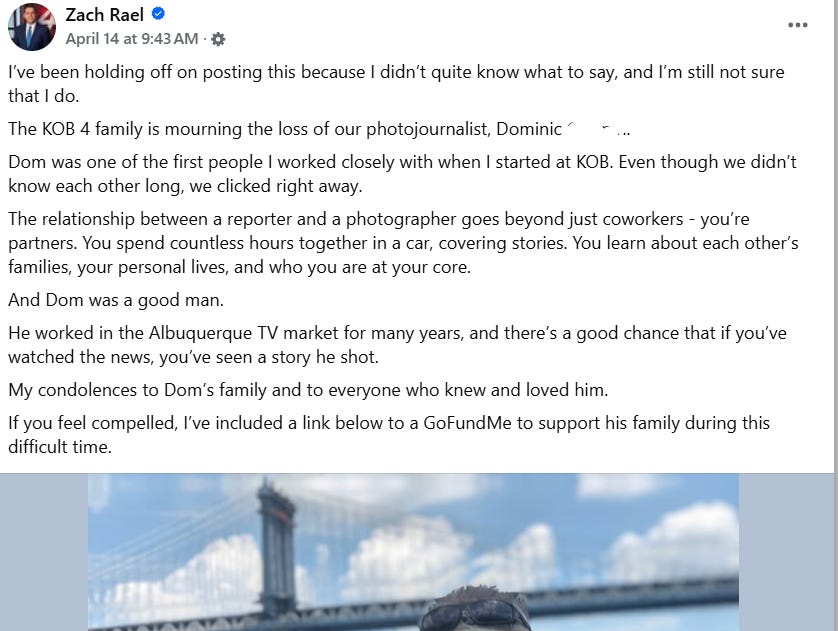
He was talking about the loss of a photojournalist who went by Dominic. I won’t say his last name because it’s not my place, but I have no doubt Zach meant every word he said. And those of you who have followed me for a long time probably already understand where I’m going with this.
He wrote, “I’ve been holding off on posting this because I didn’t quite know what to say, and I’m still not sure that I do. Dom was one of the first people I worked closely with when I started at KOB. Even though we didn’t know each other long, we clicked right away. The relationship between a reporter and photographer goes beyond just co-workers—you’re partners. You spend countless hours together in a car covering stories. You learn about each other’s families, your personal lives, and who you are at your core. And Dom was a good man. He worked in the Albuquerque TV market for many years, and there’s a good chance that if you watch the news, you’ve seen the stories he shot. My condolences to Dom’s family and to everyone who knew and loved him. If you feel compelled, I’ve included a link below to a GoFundMe.”
That GoFundMe raised over $20,000 of a $22,000 goal, and a lot of you already know my stance on GoFundMe, but that’s not the point here.
The point is the language that followed. I believe his stepdaughter wrote the description, and again, it’s heartfelt. It says, “To know Dominic was to feel his kindness. He had a way of making everyone feel seen, valued, and loved. He lived by ‘amor,’ a word he often used and embodied every day. His love for his family, his friends, his work, and even strangers was genuine and unwavering. He was the kind of person who would show up without hesitation, offer a helping hand, and lift others up with his words and presence.”
And then comes the next paragraph: “Dominic passed away unexpectedly after a difficult battle with mental health.”
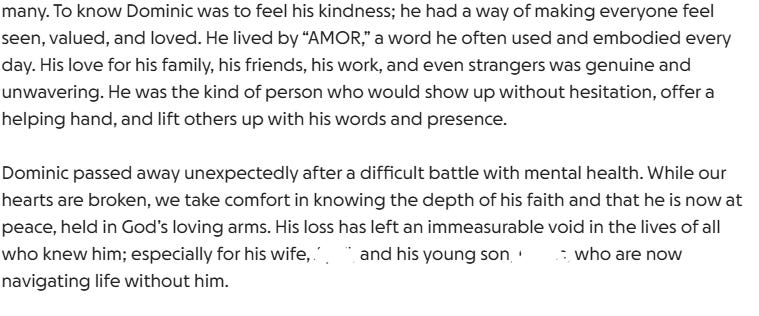
That sentence right there is what stopped me. Because to me, it’s an oxymoron. A “battle” implies time. It implies something ongoing, something fought over days, months, maybe years. “Unexpectedly” implies sudden, out of nowhere, something no one could have seen coming. Those two ideas don’t really line up. If someone is in a difficult, ongoing battle with mental health, then we should understand that there is a possibility—an unfortunate one—that it could lead to death, to suicide, to someone doing something irreversible. So when we say “unexpectedly,” it almost feels like we’re admitting that, despite all those words about how deeply we knew this person—how kind they were, how loving they were, how they showed up for everyone—we still didn’t actually see what was happening.
And that’s the part that keeps coming up for me. We say someone had a “genuine and unwavering” love for everyone around them. We say they made people feel seen. We say they showed up for others. But then when they die by suicide, we say it was unexpected. Which one is it? Did we really know them, or did we just know the version of them they showed us and we aren’t good at helping?
This euphemism—“passed away after a battle with mental health”—has become very common.
You hear it on entertainment shows, on national news, everywhere. It’s the new way of saying someone killed themselves without actually saying it. But not every situation is the same. There are people who battle mental health for years. There are people who don’t battle—they’re just exhausted.
There are people who feel like they’ve reached the end and don’t want to continue. There are even situations like euthanasia, where people make a conscious decision because of illness. So when we apply the same blanket phrase to everything, we’re not really explaining anything—we’re just smoothing it over.
And again, I go back to the contradiction. You just told me how incredible this person was, how deeply connected they were to everyone around them, how much love they gave and received. And yet, somehow, this was unexpected. That doesn’t add up.
Is it we don’t want to believe it can happen, so we turn a blind eye?
As I mentioned earlier, we spend so little real time talking to one another that we’re not identifying these things at home, with the people closest to us. We rely on surface-level interactions and then fill in the gaps with assumptions. So when something like this happens, we fall back on language that protects us from having to confront that reality. “Unexpected.” “Battle.” “At peace.” All of it softens what actually happened.
And I’ve heard those same things said about me. “James is a great guy. James is a nice guy.” People said that even when I was in a completely different place mentally. Because what people see and what someone is actually going through aren’t always the same thing. I know that firsthand. I tried twice in the 2010s. And if you had asked people around me at the time, they probably would have described me the exact same way—good guy, nice guy, everything’s fine.
It wasn’t.
So when I read these posts, and I see the way we talk around these things instead of about them, it sticks with me. Because if we’re not being real about what happened, then we’re not being real about how to prevent it either.
Now, I understand why it would be hard for a cop to admit that he’s struggling with his mental health, especially if he’s breaking down in the middle of a room full of tough, rugged dudes. Trust me when I say there’s still a mindset—especially in a place like New Mexico—where that guy gets labeled as weak, gay, or worse, because he’s emotional about life. We’re raised to be tough, to “be a man,” to handle it. And that’s part of the problem, because that’s not what this is really about.
The cameraman in question supposedly had a “battle with mental health,” yet he “passed away unexpectedly.” Those two ideas don’t line up, and that’s where I keep coming back to this. Why don’t we treat mental health battles the same way a cop treats a call?
Every officer goes into a situation understanding that this could be the one where things go bad, where they have to defend themselves, where they have to act. They are trained to be ready, to protect and serve at all times. So as people, why don’t we approach mental health the same way? Why aren’t we more proactive? Why don’t we treat even the smallest red flag like something that could escalate into the worst possible outcome? Why aren’t we stepping in earlier, understanding that if we don’t, this could end in someone taking their own life?
This column is really inspired by a bit from George Carlin in his 1990 HBO special Doin’ It Again, where he talks about soft language and how it evolves to take the meaning out of things.
He breaks down how what we now call post-traumatic stress disorder used to be called “shell shock” during World War I. His point is simple: “I don’t like words that hide the truth. I don’t like words that conceal identity—euphemisms. American English is loaded with euphemistic language.” He says Americans have trouble dealing with reality, so we invent softer language to protect ourselves, and he argues it gets worse with every generation.
He gives a perfect example. In World War I, when a soldier’s nervous system was pushed to its absolute limit, it was called “shell shock.” Simple, direct, two syllables. Then in World War II, that same condition became “battle fatigue.” By the Korean War, it turned into “operational exhaustion.” And by the time you get to Vietnam and beyond, it’s “post-traumatic stress disorder.” Eight syllables, a hyphen, and in the process, the humanity gets stripped out of it. The words get more clinical, more distant, more sterile, and the meaning gets diluted.
And that’s the point. As the language gets softer and more complicated, it doesn’t actually help people. It just makes it easier for us to talk about without confronting what it really is. Because how many Vietnam veterans do we know who took their own lives? How many veterans have struggled or died by suicide even as mental health awareness, diagnoses, and treatment options have expanded? At some point, it feels like we shifted from trying to understand the condition to managing it, labeling it, and in some cases, building systems around treating it rather than solving it.
And in doing that, we lost something. We lost the directness. We lost the urgency. We lost the meaning behind the words. And when you lose that, you start to lose the ability to recognize what’s actually happening in front of you and how serious it really is.
That’s what this all comes back to. The language we use doesn’t just describe reality—it shapes how we respond to it. And when the language gets too soft, too indirect, too sanitized, it doesn’t just hide the truth. It delays action.
I really think being soft with language—and being soft in how we interact with people who are struggling the most—is one of the worst things that could happen to mental health. Because what we’ve done is reduce something serious into something passive. We throw a three-digit number like 988 on TV screens, on websites, at the bottom of news stories, and we treat it like we’ve done our part.
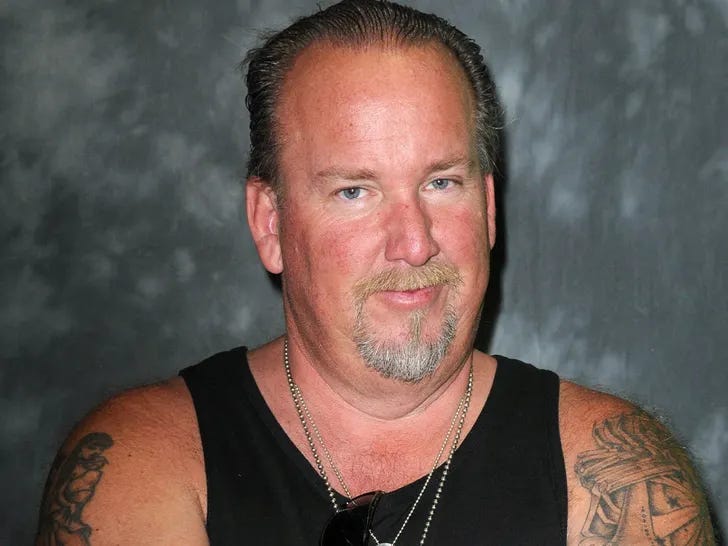
As I was finishing writing this, a story came out about Darrell Sheets, the “wow factor” guy from the A&E show Storage Wars. TMZ reported that he died at age 67 from a self-inflicted gunshot wound to the head. And while they don’t explicitly say “suicide,” we all know what that means. There’s no reason to dance around it. He didn’t “lose a battle.” He killed himself.
And what’s wild is, I didn’t know the guy personally. I only knew him from watching hundreds of episodes of that show. But on TV, he came off like a happy-go-lucky guy. Successful. Made a lot of money. Retired to Lake Havasu, Arizona. Probably had a boat, probably out on the lake, living what most people would call the American dream after grinding for years. He even had an antique store selling items he’d picked up along the way. From the outside looking in, it looked like he was living his best life.
And yet, he shot himself in the head.
Now sure, he had heart issues back in 2019, and health problems can mess with you. But again, I’m going off what people saw publicly. He was around crews, cast members, people who worked with him for years. Nobody saw anything? Nobody thought, “Hey, something’s off here”? And then the story drops, and it’s tragic, and it’s sad, and there’s a picture of him, and it says “RIP,” and right underneath it is that standard line:
“If you or someone you know is struggling or in crisis, help is available. Call or text 988…”
And that’s where I have a problem.
Because if I’m someone who is actually suicidal, reading that story, that one italicized line at the bottom might sway me—but 99.9% of the time, it’s not going to. And then when something happens, people say, “Well, we gave them resources.” That’s the word—resources. We gave them a number. We gave them a website. We did our part.
But people don’t like talking on the phone. Some people don’t like texting either. So how exactly are we helping when we just throw that out there and hope it sticks?
You can teach a man to fish, sure. But if you don’t explain what the stick and the line are actually for, he’s not going to catch anything. He’s just standing there holding equipment he doesn’t understand.
That’s what 988 feels like sometimes. It’s a throwaway line that makes us feel like we’ve addressed the issue without actually engaging with it.
And that’s the bigger problem. We pick and choose how we talk about suicide depending on the situation. We decide which people deserve sympathy and which people don’t. We soften language when it’s convenient. We over-explain when it’s uncomfortable. We avoid direct conversations about how real-life situations—divorces, financial stress, legal battles, identity, purpose—can push someone into a place they can’t get out of.
We saw that with the former lieutenant governor situation. We see it when we honor a police officer but strip meaning away from his death by saying he “succumbed to the pressures of life” instead of saying he couldn’t take it anymore. We see it with the cameraman who supposedly fought a long battle with mental health, yet somehow his death was “unexpected.” Nothing about that is unexpected. It was all there. We just didn’t want to see it.
And that’s on us.
Because at the end of the day, this doesn’t get fixed with softer language or generic resources. It gets fixed with real conversations, real awareness, and actually paying attention to the people in our lives before it gets to that point. If we don’t start doing that, suicide is going to continue to grow as a problem.
The last column I wrote here was about the Rio Grande Gorge Bridge and the number of people who have taken their lives there. The reason I even started writing “Formerly Problematic” again is because a couple of weeks ago, there was another one—a 19-year-old kid. Whole life ahead of him. Security presence on the bridge. Pedestrian restrictions. Call boxes for help. Every measure you can think of.
He still jumped.
And what did we hear afterward? “He was such a nice kid. Such a great kid. We didn’t see the signs. What is going on with our youth?” The same lines we always hear. And instead of having a real conversation about how to actually address the issue, the next discussion turns into how to spend $8 million of taxpayer money to build a fence so we don’t have to look at the problem anymore and we can find ANOTHER way of not having to deal with suicidal people
That’s not solving anything. That’s avoiding it.
And that’s exactly why I talk about this the way I do.
See you in part two.
James